Core Semiconductor Processes : Step 4 of 11

Nanoimprint
Lithography (NIL)

At Nanosystems JP Inc., we offer sub-50nm patterning at a fraction of e-beam cost. UV-NIL with soft mold for volume production up to ~500×500mm. Thermal NIL for PMMA/PC/PET thermoplastics. High refractive index resist for photonics. Master mold fabrication in Si, quartz, Ni, and polymer, and full post-imprint processing.

UV NIL soft moldThermal NIL PMMA/PC/PETHigh-n resist~500×500mmSi/Quartz/Ni/Polymer mastersDry etch + ashingMLA · Metasurfaces · VR-ARDNA nanopores · LSPR
50nm
Min feature size
~500×500mm
Max substrate
2
NIL types: UV & Thermal
4
Master mold materials
Two NIL Methods
UV and thermal nanoimprinting

At Nanosystems JP Inc., we offer UV and thermal nanoimprinting and mold fabrication. Nanoimprint lithography transfers a nanopattern from a mold to resist by direct contact, enabling sub-50nm features at far lower cost than e-beam for volume production.

💡

UV Nanoimprinting (UV-NIL)

Soft polymer mold pressed into UV-curable resist, exposed by UV, then demolded. The soft mold protects the expensive master across thousands of imprint cycles, essential for volume production. High refractive index (high-n) NIL resist available for optical waveguides, metasurface lenses, and anti-reflection structures. Large substrate capability to approximately 500×500mm.

Soft moldUV-curable resist~500×500mmHigh-n resistThousands of imprint cyclesVolume production
UV Nanoimprint Lithography (UV-NIL)
4-Step Process Flow · Sub-10 nm Resolution · Soft-Mold Based
Nanosystems JP Inc.
Step 01
Substrate & Resist
Silicon Substrate NIL Resist (High-n)
High-refractive-index NIL resist is spin-coated uniformly onto the substrate.
Step 02
Pressing
Silicon Substrate NIL Resist SOFT MOLD (PDMS)
UV-transparent soft mold contacts the resist under controlled pressure.
Soft mold protects the expensive quartz / fused silica master mold.
Step 03
UV Curing
CURING ↯ Silicon Substrate
UV light through the soft mold cross-links and hardens the polymer resist.
Step 04
Release
Silicon Substrate Λ
Mold is removed to reveal the final nano-patterned surface (period Λ).
Legend
Silicon Substrate
NIL Resist
Soft Mold (PDMS)
UV Light
Λ = grating period  |  hν = photon energy
🌡️

Thermal Nanoimprinting

Substrate heated above glass transition temperature, hard mold pressed in, cooled, demolded, no UV required. Works directly on PMMA, PC, and PET thermoplastic substrates without any resist coating step. The most direct route to nanopatterned polymer biochips, optical diffusers, and display optical films. Also used to replicate nanostructures into polymer substrates during injection molding.

PMMA · PC · PETNo resist requiredHard moldInjection mold NILOptical films
Thermal Nanoimprint Lithography (T-NIL)
4-Step Process Flow · High-Viscosity Thermoplastic Resist · Heat & Pressure Based
Nanosystems JP Inc.
Step 01
Substrate & Resist
Silicon Substrate Thermoplastic Resist (PMMA) T < Tg
Thermoplastic resist (e.g. PMMA) spin-coated onto substrate at room temperature, below glass transition Tg.
Step 02
Heat & Press
Silicon Substrate Resist (T > Tg, softened) HARD MOLD (Quartz / Si) ~120–200°C
Stack heated above Tg; hard mold pressed into softened resist under high pressure.
High pressure + heat forces resist into all mold cavities.
Step 03
Cooling
Silicon Substrate Resist Hardened (T < Tg) HARD MOLD (still in contact) Cool → T < Tg
Stack cooled below Tg with mold still in place - resist solidifies, locking in the nano-pattern.
Step 04
Release
Silicon Substrate Λ RLT
Mold separated to reveal final nano-patterned resist. Residual layer (RLT) removed in subsequent etch step.
Legend
Silicon Substrate
Thermoplastic Resist (PMMA)
Hard Mold (Quartz / Si)
Heat
Cooling
Λ = grating period  |  RLT = residual layer thickness  |  Tg = glass transition temp.
🔧

Master Mold Fabrication

We fabricate the master mold itself, silicon (e-beam direct-write + DRIE), quartz (e-beam + etch), nickel (electroformed from Si master), or polymer. At Nanosystems JP Inc., we handle mold creation, NIL, dry etch, and ashing as a single coordinated flow. Critical for IP protection: your nanoscale pattern design stays with us from first design through to finished chip.

Si e-beam + DRIEQuartzNi electroformedPolymer moldIP protected
⚙️

Post-Imprint Processing

Complete integration after NIL: dry etching to transfer the imprinted pattern into the substrate material (Si, SiO₂, glass), O₂ plasma ashing to remove the thin residual NIL resist layer that remains after demolding, and mold cleaning protocols to preserve mold lifetime across hundreds to thousands of imprint cycles.

Dry etch pattern transferO₂ plasma ashingResidual layer removalMold cleaningMold lifetime optimized
🔭

High-n Resist for Photonics

Specialist high refractive index (high-n) NIL resist for fabricating optical waveguides, metasurface lenses, and anti-reflection moth-eye structures. The high refractive index contrast between the imprinted structure and surrounding medium enables strong optical guiding, diffraction, and reflection control, critical for AR/VR waveguide gratings and LiDAR optical elements.

High refractive indexWaveguidesMetasurface lensesAnti-reflectionAR/VR · LiDAR
📐

Large-Area UV-NIL

UV-NIL on substrates up to approximately 500×500mm, enabling large-area microlens arrays, display optical films, and panel-scale biochip substrates that 4–6 inch wafer NIL tools cannot process. Large-area NIL is particularly important for display optics (anti-glare, brightness enhancement), solar cell texturing, and biochip array substrates where large format is required for cost-effective chip production.
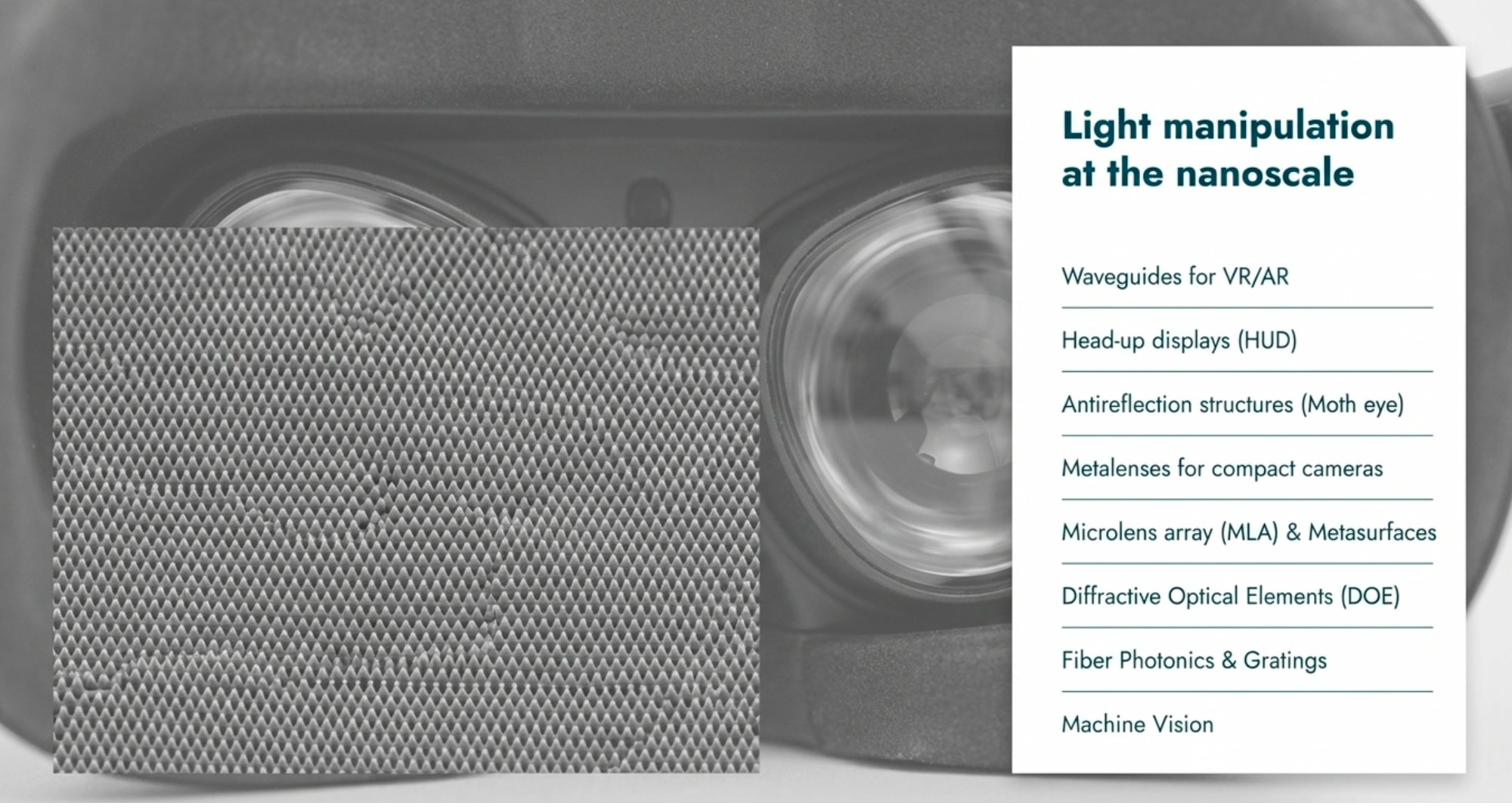
~500×500mmLarge-area MLADisplay opticsSolar texturingPanel biochip
NIL Process Specifications
Complete parameter table
ProcessMin FeatureSubstrate SizeToolingNotes
UV-NIL~50nm~500×500mmSoft moldUV-curable; high-n resist option; volume production
Thermal NIL~100nmWafer/panel formatHard moldPMMA/PC/PET direct; injection mold NIL
Master, Si~20nm (e-beam)Up to 8 inchE-beam + DRIEHighest resolution masters; reusable
Master, Quartz~20nm (e-beam)Up to 8 inchE-beam + etchUV-transparent; hard mold
Master, Ni (electroformed)Sub-µmWafer-limitedElectroforming from SiProduction mold; high durability
Master, Polymer~1µmUp to 500×500mmCasting from SiSoft mold; UV-NIL volume
Post-imprint dry etchPattern-dependentSame as substrateRIE/ICPSi/SiO₂/glass pattern transfer
O₂ plasma ashingAll wafer sizesPlasmaResidual resist removal
Applications
Nanoimprinting across photonics, bio, and security
🔵

Microlens Arrays (MLA)

Large-area MLA for camera modules, display collimation, LiDAR beam shaping, and diffuser films. UV-NIL replicates MLA geometry from a single Si master across the full substrate in one imprint step, far faster and cheaper than MEMS etching for the same feature.

UV-NIL · Si/Ni master · Large-area · Camera · Display · LiDAR
🌀

Metasurfaces & DOE

Sub-wavelength diffractive optical elements and flat metalenses with features below 200nm. E-beam master fabricated, then replicated by UV-NIL for cost-effective volume production of AR/VR waveguide gratings, beam splitters, and holographic optical elements.

E-beam master → UV-NIL · DOE · Flat optics · AR/VR · Holographic
🧬

DNA Nanopores

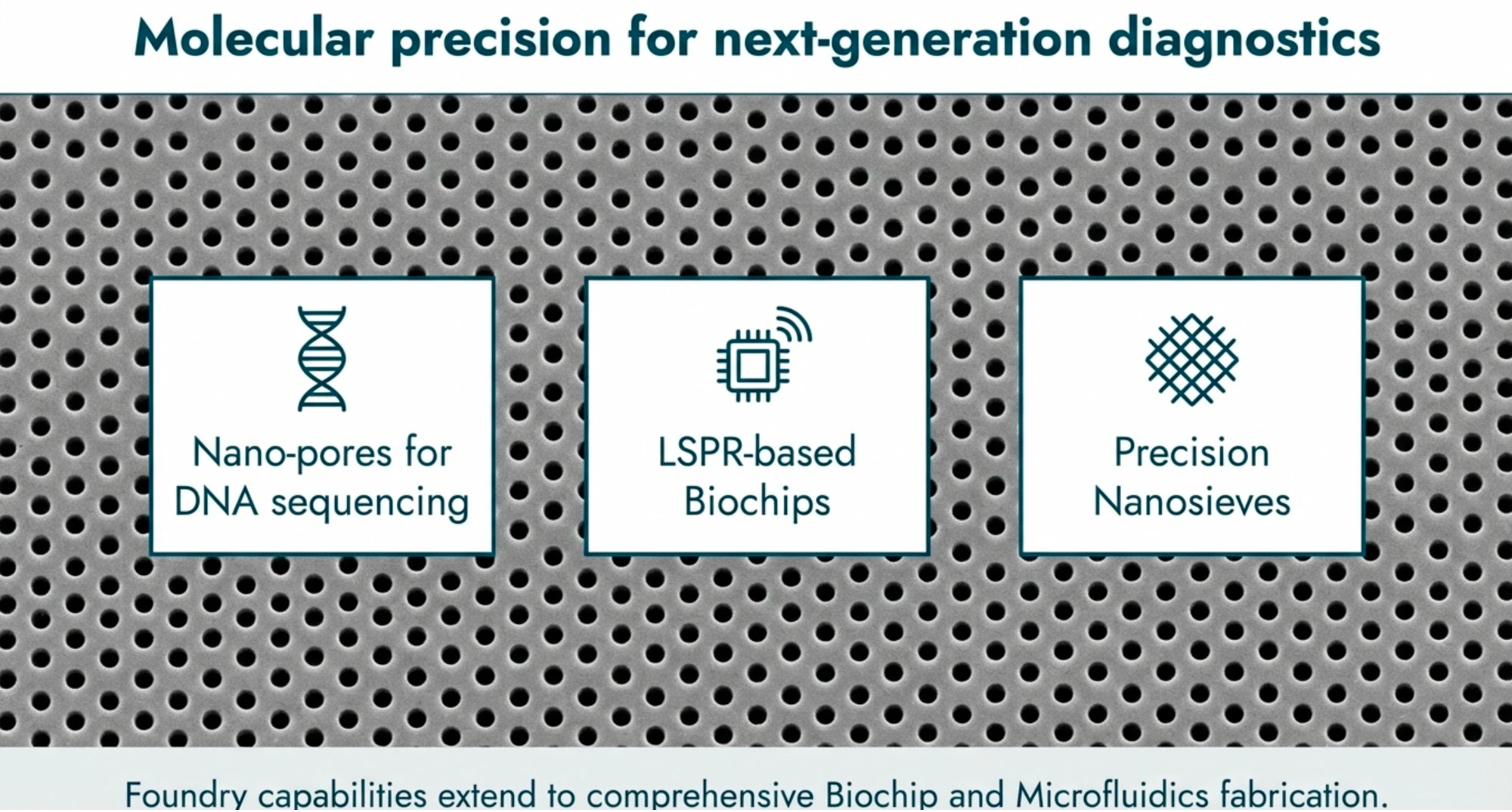
Sub-50nm nanopore arrays for DNA sequencing and molecular sieving. NIL defines the pore geometry in resist; dry etch transfers to SiN or Si membrane. Uniform pore size and pitch across large arrays, critical for consistent nanopore sequencing performance.

NIL → dry etch → SiN membrane · Sub-50nm · DNA sequencing
🔆

LSPR Biosensors

Nanostructured gold arrays (pillars, holes, crescents) for localised surface plasmon resonance biosensing. NIL patterns the nanostructure in resist; lift-off deposits gold. Label-free detection of proteins, nucleic acids, and small molecules for clinical diagnostics.

NIL + Au lift-off · LSPR · Plasmonic · Label-free biosensing
🥽

VR/AR Waveguide Gratings

High-n NIL grating imprinted directly into waveguide substrate for AR/VR head-up displays. The high refractive index contrast of the high-n resist creates the strong diffraction efficiency required for compact waveguide combiners. Combines with ICP-RIE for final grating depth control.

High-n resist · UV-NIL · ICP-RIE · Waveguide combiner · AR/VR HUD
🔐

Security Microstructures

Anti-counterfeiting holograms, diffraction gratings, and nano-ID structures for banknotes, product authentication, and high-security tickets. UV-NIL or thermal NIL creates optically active nanostructures invisible to conventional printing, verifiable only under specific illumination.

UV-NIL · Hologram · Diffraction grating · Banknote · Anti-counterfeiting
Nanoimprinting for HUD - Head-Up Display waveguide grating fabrication
APPLICATION

HUD Waveguide Gratings

Nanoimprinting for Head-Up Display waveguide coupler and exit pupil expander gratings. UV-NIL replicates sub-wavelength grating structures from a master mold with the uniformity and throughput required for automotive and AR display optics production.

Nanoimprinting for diagnostic devices - lab-on-chip nanostructure fabrication
APPLICATION

Diagnostic & Biosensor Devices

Nanostructured surfaces for point-of-care diagnostics, lab-on-chip fluidic channels, and surface-enhanced biosensors. NIL enables cost-effective replication of nanoscale features on polymer or glass substrates for medical diagnostic and analytical instrument applications.

Why Nanosystems JP Inc.
Master mold to finished chip, one project
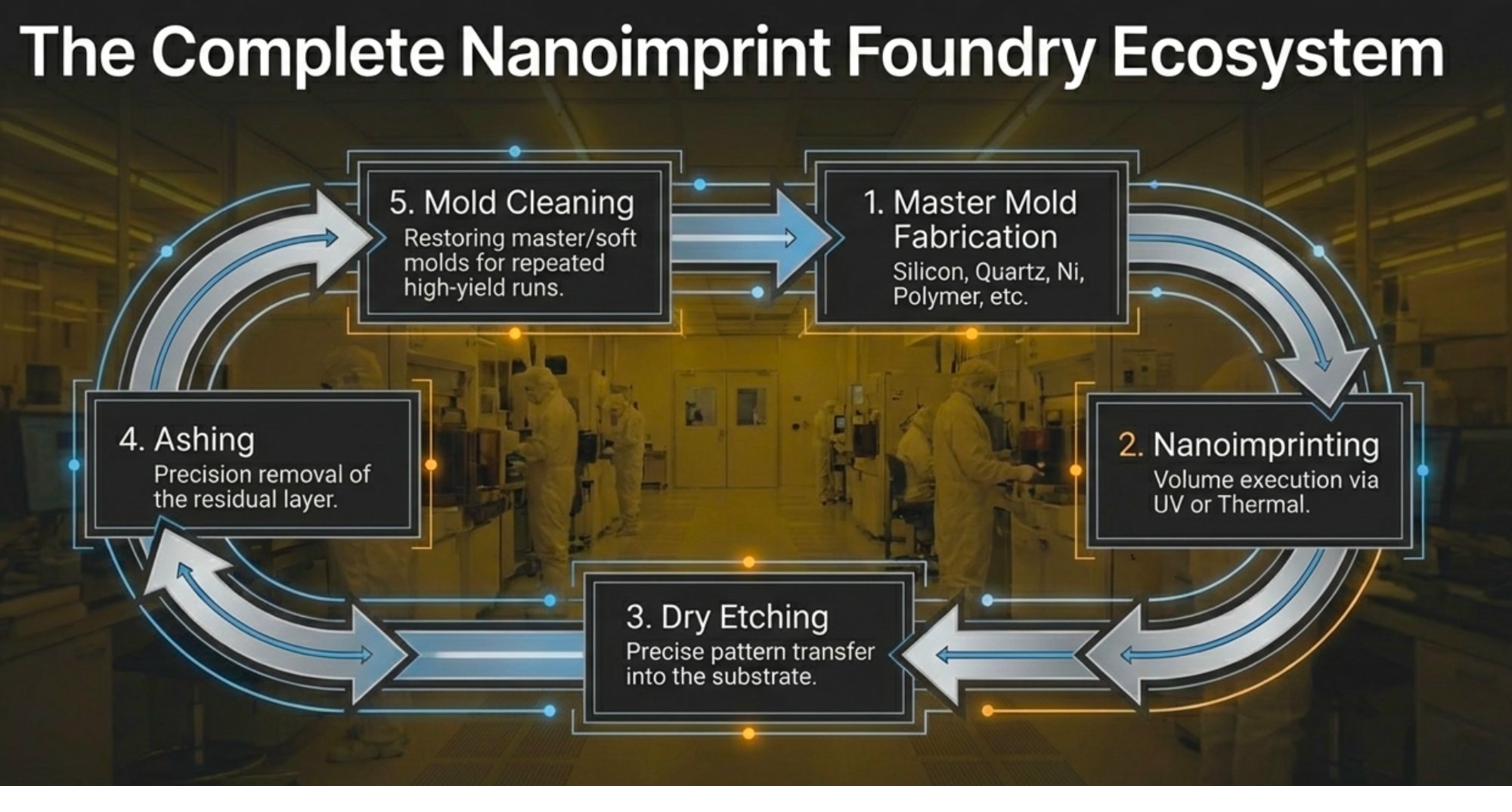
The Complete Nanoimprint Foundry Ecosystem - 5-step cycle: Master Mold Fabrication, Nanoimprinting, Dry Etching, Ashing, Mold Cleaning
01

50nm at production cost

NIL replicates sub-50nm features in volume at 10–100× lower cost than direct-write e-beam. Prototype with e-beam, produce with NIL — one project.

02

Mold-to-chip flow

Si / quartz / fused silica / Ni master fabrication, NIL, dry etch, and ashing, coordinated without external vendors. Your nanoscale pattern stays from first design to finished chip.

03

~500×500mm large-area capability

Most NIL facilities top out at 4–6 inch wafer formats. Our large-area UV-NIL capability handles display optics, MLA, and panel biochips at panel scale.

04

High-n resist for photonics

Specialist high refractive index resist for photonic waveguides and metasurfaces, a capability specific to photonic NIL not widely available at standard foundries.

05

Thermal NIL on polymer substrates

Direct nanostructuring of PMMA, PC, and PET without resist coating, enabling polymer-substrate nanophotonic chips and injection-molded nanostructured parts.

06

From 1 wafer prototype

Prototype a new mold design on a single wafer to verify imprint quality, residual layer thickness, and pattern transfer before committing to production volumes.

Next in your process flow

Thin Film Deposition: After NIL patterning, functional thin films, metals, ALD dielectrics, optical coatings, are deposited onto the imprinted nanostructures.

Thin Film Deposition →

🔴 Nanoimprint mold cleaning: We provide piranha (SPM) wet cleaning and O₂ plasma ashing for mold restoration between imprint cycles - removing resist residues and carbonaceous deposits without damaging fine mold features.

Mold cleaning details →

Start your project.
Response within 1 business day.

Share your process requirements, substrate, and production volume, A Nanosystems JP Inc. engineer will respond within 1 business day. Full quote typically within 7–10 business days, subject to project complexity and NDA requirements.

[email protected] · +81-3-5288-5569 · NDA available

All Services
Full process flow →
Substrates
🔷 Substrate & WafersSi, SiC, GaN, glass, sapphire 🔬 Fused Silica WafersQuartz · borosilicate · low CTE 🟣 PI Film & SUS Sensor FabRoll-to-roll · sensor patterning
Front-End
🎭 Mask FabricationGDS to chrome mask, DRC 💡 PhotolithographyE-beam 20nm to 500×600mm 🔬 NanoimprintingUV & thermal NIL 🔵 Thin Film DepositionPVD, CVD, ALD, MBE ⬆️ LiftoffMetal pattern · shadow mask ⚡ ElectroplatingCu TSV fill, DPC, LIGA ⚗️ EtchingICP-RIE, DRIE >50:1 🌡️ AnnealingN₂/H₂/vacuum/RTA 🎯 Ion ImplantationB/P/As/Al/N implant 🔶 CMP & GrindingCu CMP, 50µm thinning ✂️ DicingBlade, stealth laser 🧪 Wafer CleaningRCA, plasma, megasonic
Advanced Packaging
🔗 Wafer BondingHybrid, eutectic, fusion 📌 TSV FabricationHigh AR, void-free Cu fill 🔓 TSV RevealBackgrind → etch → CMP 🪟 TGV FabricationThrough-glass via 📐 RDL FabricationBCB/PBO/PI + damascene 📦 Packaging & AssemblyWire bond, flip-chip 📚 3D/2.5D PackagingTSV+RDL+UBM+C4 🥇 AuSn BumpPVD lift-off, fluxless 🧬 Biochip & MicrofluidicsGlass 500×600mm, NIL 🔆 SiPho PackagingTSV·RDL·UBM·C4 for PIC
Industries
🤖 AI & HPC PackagingCoWoS-style, 2.5D/3D 💎 Silicon PhotonicsSOI · AuSn · TSV interposer 🚗 AutomotiveMEMS sensors, SiC power 🧬 Life SciencesLab-on-chip, biosensors 🔭 All Industries → Request a Quote →
PE html> Nanoimprinting (NIL) — UV, Thermal, 500×500mm Panels | Nanosystems JP Inc.
Core Semiconductor Processes : Step 4 of 11

Nanoimprint
Lithography (NIL)

At Nanosystems JP Inc., we offer sub-50nm patterning at a fraction of e-beam cost. UV-NIL with soft mold for volume production up to ~500×500mm. Thermal NIL for PMMA/PC/PET thermoplastics. High refractive index resist for photonics. Master mold fabrication in Si, quartz, Ni, and polymer, and full post-imprint processing.

UV NIL soft moldThermal NIL PMMA/PC/PETHigh-n resist~500×500mmSi/Quartz/Ni/Polymer mastersDry etch + ashingMLA · Metasurfaces · VR-ARDNA nanopores · LSPR
50nm
Min feature size
~500×500mm
Max substrate
2
NIL types: UV & Thermal
4
Master mold materials
Two NIL Methods
UV and thermal nanoimprinting

At Nanosystems JP Inc., we offer UV and thermal nanoimprinting and mold fabrication. Nanoimprint lithography transfers a nanopattern from a mold to resist by direct contact, enabling sub-50nm features at far lower cost than e-beam for volume production.

💡

UV Nanoimprinting (UV-NIL)

Soft polymer mold pressed into UV-curable resist, exposed by UV, then demolded. The soft mold protects the expensive master across thousands of imprint cycles, essential for volume production. High refractive index (high-n) NIL resist available for optical waveguides, metasurface lenses, and anti-reflection structures. Large substrate capability to approximately 500×500mm.

Soft moldUV-curable resist~500×500mmHigh-n resistThousands of imprint cyclesVolume production
UV Nanoimprint Lithography (UV-NIL)
4-Step Process Flow · Sub-10 nm Resolution · Soft-Mold Based
Nanosystems JP Inc.
Step 01
Substrate & Resist
Silicon Substrate NIL Resist (High-n)
High-refractive-index NIL resist is spin-coated uniformly onto the substrate.
Step 02
Pressing
Silicon Substrate NIL Resist SOFT MOLD (PDMS)
UV-transparent soft mold contacts the resist under controlled pressure.
Soft mold protects the expensive quartz / fused silica master mold.
Step 03
UV Curing
CURING ↯ Silicon Substrate
UV light through the soft mold cross-links and hardens the polymer resist.
Step 04
Release
Silicon Substrate Λ
Mold is removed to reveal the final nano-patterned surface (period Λ).
Legend
Silicon Substrate
NIL Resist
Soft Mold (PDMS)
UV Light
Λ = grating period  |  hν = photon energy
🌡️

Thermal Nanoimprinting

Substrate heated above glass transition temperature, hard mold pressed in, cooled, demolded, no UV required. Works directly on PMMA, PC, and PET thermoplastic substrates without any resist coating step. The most direct route to nanopatterned polymer biochips, optical diffusers, and display optical films. Also used to replicate nanostructures into polymer substrates during injection molding.

PMMA · PC · PETNo resist requiredHard moldInjection mold NILOptical films
Thermal Nanoimprint Lithography (T-NIL)
4-Step Process Flow · High-Viscosity Thermoplastic Resist · Heat & Pressure Based
Nanosystems JP Inc.
Step 01
Substrate & Resist
Silicon Substrate Thermoplastic Resist (PMMA) T < Tg
Thermoplastic resist (e.g. PMMA) spin-coated onto substrate at room temperature, below glass transition Tg.
Step 02
Heat & Press
Silicon Substrate Resist (T > Tg, softened) HARD MOLD (Quartz / Si) ~120–200°C
Stack heated above Tg; hard mold pressed into softened resist under high pressure.
High pressure + heat forces resist into all mold cavities.
Step 03
Cooling
Silicon Substrate Resist Hardened (T < Tg) HARD MOLD (still in contact) Cool → T < Tg
Stack cooled below Tg with mold still in place - resist solidifies, locking in the nano-pattern.
Step 04
Release
Silicon Substrate Λ RLT
Mold separated to reveal final nano-patterned resist. Residual layer (RLT) removed in subsequent etch step.
Legend
Silicon Substrate
Thermoplastic Resist (PMMA)
Hard Mold (Quartz / Si)
Heat
Cooling
Λ = grating period  |  RLT = residual layer thickness  |  Tg = glass transition temp.
🔧

Master Mold Fabrication

We fabricate the master mold itself, silicon (e-beam direct-write + DRIE), quartz (e-beam + etch), nickel (electroformed from Si master), or polymer. At Nanosystems JP Inc., we handle mold creation, NIL, dry etch, and ashing as a single coordinated flow. Critical for IP protection: your nanoscale pattern design stays with us from first design through to finished chip.

Si e-beam + DRIEQuartzNi electroformedPolymer moldIP protected
⚙️

Post-Imprint Processing

Complete integration after NIL: dry etching to transfer the imprinted pattern into the substrate material (Si, SiO₂, glass), O₂ plasma ashing to remove the thin residual NIL resist layer that remains after demolding, and mold cleaning protocols to preserve mold lifetime across hundreds to thousands of imprint cycles.

Dry etch pattern transferO₂ plasma ashingResidual layer removalMold cleaningMold lifetime optimized
🔭

High-n Resist for Photonics

Specialist high refractive index (high-n) NIL resist for fabricating optical waveguides, metasurface lenses, and anti-reflection moth-eye structures. The high refractive index contrast between the imprinted structure and surrounding medium enables strong optical guiding, diffraction, and reflection control, critical for AR/VR waveguide gratings and LiDAR optical elements.

High refractive indexWaveguidesMetasurface lensesAnti-reflectionAR/VR · LiDAR
📐

Large-Area UV-NIL

UV-NIL on substrates up to approximately 500×500mm, enabling large-area microlens arrays, display optical films, and panel-scale biochip substrates that 4–6 inch wafer NIL tools cannot process. Large-area NIL is particularly important for display optics (anti-glare, brightness enhancement), solar cell texturing, and biochip array substrates where large format is required for cost-effective chip production.
~500×500mmLarge-area MLADisplay opticsSolar texturingPanel biochip
NIL Process Specifications
Complete parameter table
ProcessMin FeatureSubstrate SizeToolingNotes
UV-NIL~50nm~500×500mmSoft moldUV-curable; high-n resist option; volume production
Thermal NIL~100nmWafer/panel formatHard moldPMMA/PC/PET direct; injection mold NIL
Master, Si~20nm (e-beam)Up to 8 inchE-beam + DRIEHighest resolution masters; reusable
Master, Quartz~20nm (e-beam)Up to 8 inchE-beam + etchUV-transparent; hard mold
Master, Ni (electroformed)Sub-µmWafer-limitedElectroforming from SiProduction mold; high durability
Master, Polymer~1µmUp to 500×500mmCasting from SiSoft mold; UV-NIL volume
Post-imprint dry etchPattern-dependentSame as substrateRIE/ICPSi/SiO₂/glass pattern transfer
O₂ plasma ashingAll wafer sizesPlasmaResidual resist removal
Applications
Nanoimprinting across photonics, bio, and security
🔵

Microlens Arrays (MLA)

Large-area MLA for camera modules, display collimation, LiDAR beam shaping, and diffuser films. UV-NIL replicates MLA geometry from a single Si master across the full substrate in one imprint step, far faster and cheaper than MEMS etching for the same feature.

UV-NIL · Si/Ni master · Large-area · Camera · Display · LiDAR
🌀

Metasurfaces & DOE

Sub-wavelength diffractive optical elements and flat metalenses with features below 200nm. E-beam master fabricated, then replicated by UV-NIL for cost-effective volume production of AR/VR waveguide gratings, beam splitters, and holographic optical elements.

E-beam master → UV-NIL · DOE · Flat optics · AR/VR · Holographic
🧬

DNA Nanopores

Sub-50nm nanopore arrays for DNA sequencing and molecular sieving. NIL defines the pore geometry in resist; dry etch transfers to SiN or Si membrane. Uniform pore size and pitch across large arrays, critical for consistent nanopore sequencing performance.

NIL → dry etch → SiN membrane · Sub-50nm · DNA sequencing
🔆

LSPR Biosensors

Nanostructured gold arrays (pillars, holes, crescents) for localised surface plasmon resonance biosensing. NIL patterns the nanostructure in resist; lift-off deposits gold. Label-free detection of proteins, nucleic acids, and small molecules for clinical diagnostics.

NIL + Au lift-off · LSPR · Plasmonic · Label-free biosensing
🥽

VR/AR Waveguide Gratings

High-n NIL grating imprinted directly into waveguide substrate for AR/VR head-up displays. The high refractive index contrast of the high-n resist creates the strong diffraction efficiency required for compact waveguide combiners. Combines with ICP-RIE for final grating depth control.

High-n resist · UV-NIL · ICP-RIE · Waveguide combiner · AR/VR HUD
🔐

Security Microstructures

Anti-counterfeiting holograms, diffraction gratings, and nano-ID structures for banknotes, product authentication, and high-security tickets. UV-NIL or thermal NIL creates optically active nanostructures invisible to conventional printing, verifiable only under specific illumination.

UV-NIL · Hologram · Diffraction grating · Banknote · Anti-counterfeiting
Nanoimprinting for HUD - Head-Up Display waveguide grating fabrication
APPLICATION

HUD Waveguide Gratings

Nanoimprinting for Head-Up Display waveguide coupler and exit pupil expander gratings. UV-NIL replicates sub-wavelength grating structures from a master mold with the uniformity and throughput required for automotive and AR display optics production.

Nanoimprinting for diagnostic devices - lab-on-chip nanostructure fabrication
APPLICATION

Diagnostic & Biosensor Devices

Nanostructured surfaces for point-of-care diagnostics, lab-on-chip fluidic channels, and surface-enhanced biosensors. NIL enables cost-effective replication of nanoscale features on polymer or glass substrates for medical diagnostic and analytical instrument applications.

Why Nanosystems JP Inc.
Master mold to finished chip, one project
The Complete Nanoimprint Foundry Ecosystem - 5-step cycle: Master Mold Fabrication, Nanoimprinting, Dry Etching, Ashing, Mold Cleaning
01

50nm at production cost

NIL replicates sub-50nm features in volume at 10–100× lower cost than direct-write e-beam. Prototype with e-beam, produce with NIL — one project.

02

Mold-to-chip flow

Si / quartz / fused silica / Ni master fabrication, NIL, dry etch, and ashing, coordinated without external vendors. Your nanoscale pattern stays from first design to finished chip.

03

~500×500mm large-area capability

Most NIL facilities top out at 4–6 inch wafer formats. Our large-area UV-NIL capability handles display optics, MLA, and panel biochips at panel scale.

04

High-n resist for photonics

Specialist high refractive index resist for photonic waveguides and metasurfaces, a capability specific to photonic NIL not widely available at standard foundries.

05

Thermal NIL on polymer substrates

Direct nanostructuring of PMMA, PC, and PET without resist coating, enabling polymer-substrate nanophotonic chips and injection-molded nanostructured parts.

06

From 1 wafer prototype

Prototype a new mold design on a single wafer to verify imprint quality, residual layer thickness, and pattern transfer before committing to production volumes.

Next in your process flow

Thin Film Deposition: After NIL patterning, functional thin films, metals, ALD dielectrics, optical coatings, are deposited onto the imprinted nanostructures.

Thin Film Deposition →

🔴 Nanoimprint mold cleaning: We provide piranha (SPM) wet cleaning and O₂ plasma ashing for mold restoration between imprint cycles - removing resist residues and carbonaceous deposits without damaging fine mold features.

Mold cleaning details →

Start your project.
Response within 1 business day.

Share your process requirements, substrate, and production volume, A Nanosystems JP Inc. engineer will respond within 1 business day. Full quote typically within 7–10 business days, subject to project complexity and NDA requirements.

[email protected] · +81-3-5288-5569 · NDA available

All Services
Full process flow →
Substrates
🔷 Substrate & WafersSi, SiC, GaN, glass, sapphire 🔬 Fused Silica WafersQuartz · borosilicate · low CTE 🟣 PI Film & SUS Sensor FabRoll-to-roll · sensor patterning
Front-End
🎭 Mask FabricationGDS to chrome mask, DRC 💡 PhotolithographyE-beam 20nm to 500×600mm 🔬 NanoimprintingUV & thermal NIL 🔵 Thin Film DepositionPVD, CVD, ALD, MBE ⬆️ LiftoffMetal pattern · shadow mask ⚡ ElectroplatingCu TSV fill, DPC, LIGA ⚗️ EtchingICP-RIE, DRIE >50:1 🌡️ AnnealingN₂/H₂/vacuum/RTA 🎯 Ion ImplantationB/P/As/Al/N implant 🔶 CMP & GrindingCu CMP, 50µm thinning ✂️ DicingBlade, stealth laser 🧪 Wafer CleaningRCA, plasma, megasonic
Advanced Packaging
🔗 Wafer BondingHybrid, eutectic, fusion 📌 TSV FabricationHigh AR, void-free Cu fill 🔓 TSV RevealBackgrind → etch → CMP 🪟 TGV FabricationThrough-glass via 📐 RDL FabricationBCB/PBO/PI + damascene 📦 Packaging & AssemblyWire bond, flip-chip 📚 3D/2.5D PackagingTSV+RDL+UBM+C4 🥇 AuSn BumpPVD lift-off, fluxless 🧬 Biochip & MicrofluidicsGlass 500×600mm, NIL 🔆 SiPho PackagingTSV·RDL·UBM·C4 for PIC
Industries
🤖 AI & HPC PackagingCoWoS-style, 2.5D/3D 💎 Silicon PhotonicsSOI · AuSn · TSV interposer 🚗 AutomotiveMEMS sensors, SiC power 🧬 Life SciencesLab-on-chip, biosensors 🔭 All Industries → Request a Quote →
Technical AI — Nanosystems JP Inc.
Online — typically replies in minutes
Services & Industries
⚙️ Capabilities Overview
Substrates
🔷 Substrate & WafersSi, SiC, GaN, glass, sapphire 🔬 Fused Silica WafersQuartz · borosilicate · low CTE 🟣 PI Film & SUS Sensor FabRoll-to-roll · sensor patterning
Front-End
🎭 Mask FabricationGDS to chrome mask, DRC 📷 PhotolithographyE-beam 20 nm to 500×600 mm 🔬 NanoimprintingUV & thermal NIL 🫧 Thin Film DepositionPVD, CVD, ALD, MBE ⬆️ LiftoffMetal pattern · shadow mask ⚡ ElectroplatingCu TSV fill, DPC, LIGA 🌊 EtchingICP-RIE, DRIE >50:1 🔥 AnnealingN₂ / H₂ / vacuum / RTA ⚛️ Ion ImplantationB / P / As / Al / N implant 🔄 CMP & GrindingCu CMP, 50 µm thinning 💎 DicingBlade, stealth laser 🧪 Wafer CleaningRCA, plasma, megasonic
Advanced Packaging
🔗 Wafer BondingHybrid, eutectic, fusion 📌 TSV FabricationHigh AR, void-free Cu fill 👁️ TSV RevealBackgrind → etch → CMP 🪟 TGV FabricationThrough-glass via 🔀 RDL FabricationBCB / PBO / PI + damascene 📦 Packaging & AssemblyWire bond, flip-chip 📚 3D / 2.5D PackagingTSV + RDL + UBM + C4 🥇 AuSn BumpPVD lift-off, fluxless 🧬 Biochip & MicrofluidicsGlass 500×600 mm, NIL 🔆 SiPho PackagingTSV · RDL · UBM · C4 for PIC
Industries
🤖 AI & HPC PackagingCoWoS-style, 2.5D / 3D 💡 Silicon PhotonicsSOI · AuSn · TSV interposer 🚗 AutomotiveMEMS sensors, SiC power 🧬 Life SciencesLab-on-chip, biosensors 🔭 All Industries → Request a Quote →