Advanced Packaging : Step 4 of 7

RDL, Redistribution
Layer Fabrication

At Nanosystems JP Inc., we offer two complete RDL routes - polymer passivation (BCB, PBO, PI) and Cu damascene - for redistributing chip I/O from device pad pitch to package bump pitch, enabling fan-in and fan-out wafer-level packaging. Both routes are available as standalone processes or as part of a full TSV → RDL → UBM → C4 bumping flow, with integrated backgrinding, dicing, and flip-chip assembly.
BCB passivation RDL PBO low-k Polyimide RDL Acrylic dielectric Cu single damascene Cu double damascene Fan-in WLCSP Fan-out FOWLP
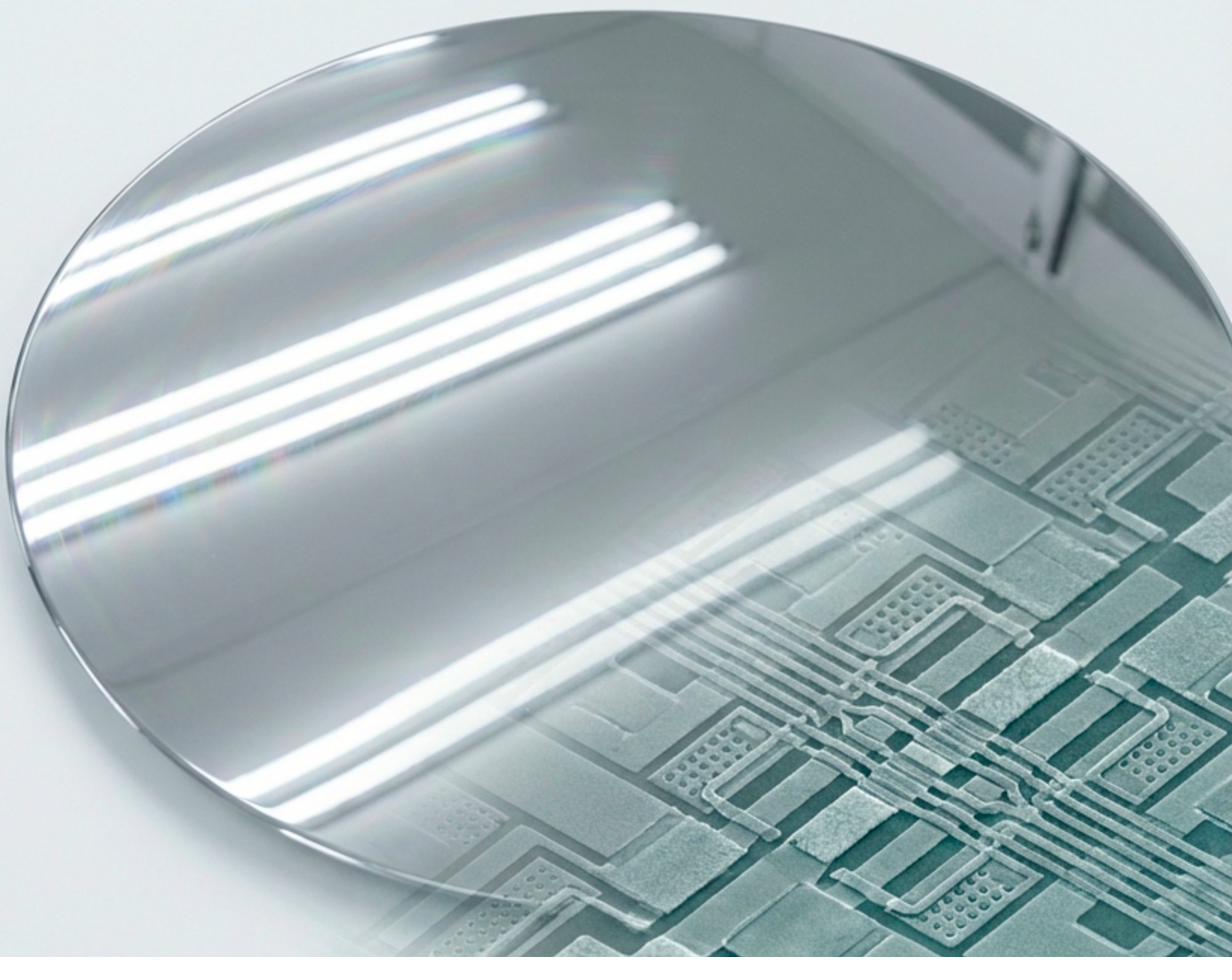
RDL wafer with redistribution layer traces - Nanosystems JP Inc.
2
RDL routes:
polymer & Cu damascene
4
Polymer dielectrics:
BCB · PBO · PI · Acrylic
<2µm
Line/space in
Cu damascene RDL
Fan-in/out
WLCSP & FOWLP
both supported
What RDL Does
Rerouting chip I/O from
pad pitch to bump pitch

Device pads on a finished wafer are typically at a pitch of 50–150µm, too tight for direct solder bumping at board assembly. RDL fabricates one or more layers of metal interconnect on top of the completed wafer to reroute these pads to a wider, solderable bump pitch, or to extend the I/O footprint beyond the die edge entirely (fan-out).

🗺️

What RDL Reroutes

After TSV reveal CMP, the wafer has clean Cu contacts flush with the dielectric. RDL takes these contacts, at via pitch, which may be 5–50µm, and fans them out to a C4 bump pitch of 100–200µm. The RDL metal layer is the only electrical connection between the TSV and the solder bump: its resistance, inductance, and layout directly affect device performance.

TSV pitch → bump pitch 1–4 metal layers typical Resistance / inductance critical Layout affects RF performance
⚖️

Choosing a Route

The two RDL routes, polymer passivation and Cu damascene, make different trade-offs. Polymer passivation is lower cost and lower temperature; Cu damascene achieves finer line/space and lower resistance for high-density applications. The dielectric choice within polymer passivation (BCB, PBO, polyimide, or acrylic) further affects dielectric constant, cure temperature, and chemical compatibility.

Polymer: lower cost Polymer: lower temp Cu damascene: finer pitch Cu damascene: lower resistance
🔗

Coordinated After TSV Reveal

RDL always follows TSV reveal or wafer-level pad preparation. When performed in the same coordinated project, the wafer moves directly from CMP to RDL lithography while the Cu contact surface is fresh and oxide-free, the most common yield loss in outsourced RDL is Cu surface contamination that accumulates during shipping and storage between vendors.

Immediate after reveal CMP No surface contamination risk No Cu re-oxidation One project
Route Comparison
Polymer passivation vs
Cu damascene, side by side

Both routes are available . Our engineers recommend the optimal route based on your required line/space density, dielectric loss target, temperature budget, and cost.

Polymer Passivation RDL

BCB · PBO · POLYIMIDE · ACRYLIC

An organic dielectric layer is spin-coated, patterned by photolithography, and cured, forming the interlayer dielectric between metal RDL layers. Cu or Al metallisation is then deposited and patterned on top. The polymer planarises the underlying topography naturally, simplifying subsequent lithography. Typical cure temperatures of 200–350°C keep the process compatible with completed CMOS devices. The main trade-off versus damascene is line/space density: standard polymer RDL achieves 5–10µm lines, whereas damascene reaches sub-2µm.

Min line/space~5µm / 5µm
Dielectric constantBCB: 2.65 · PBO: 2.9 · PI: 3.5
Cure temperature200–350°C
Metal depositionSputter + electroplate or Al PVD
CostLower, fewer steps
Best forFan-out, RF modules, MEMS WLCSP

Cu Damascene RDL

SINGLE & DOUBLE DAMASCENE

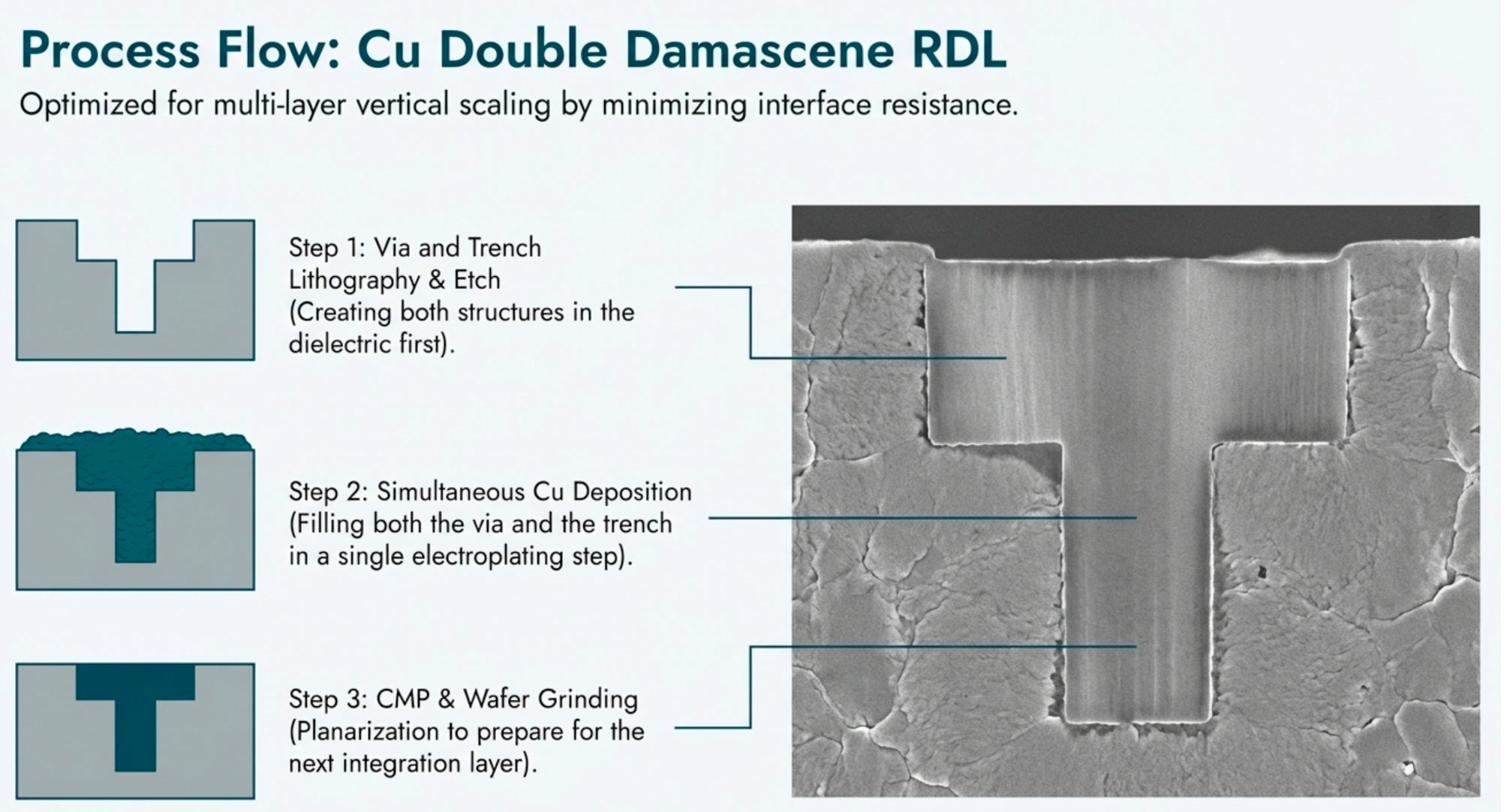
Trenches and vias are patterned into a dielectric (typically SiO₂ or low-k CVD dielectric) and then filled with Cu by electroplating, the same process as advanced CMOS BEOL interconnects. CMP planarises each layer. The inlaid Cu process eliminates the etch step on patterned Cu, enabling much finer line/space than polymer RDL while achieving lower resistance due to the pure Cu fill without adhesion layers. Double damascene forms via and trench in a single Cu fill + CMP step, reducing process steps for multi-layer RDL.

Min line/space<2µm / 2µm
DielectricSiO₂ or CVD low-k
MetalElectroplated Cu (inlaid)
CMPRequired after each layer
CostHigher, more steps
Best forChiplet interposers, HPC, 2.5D
Process Flow
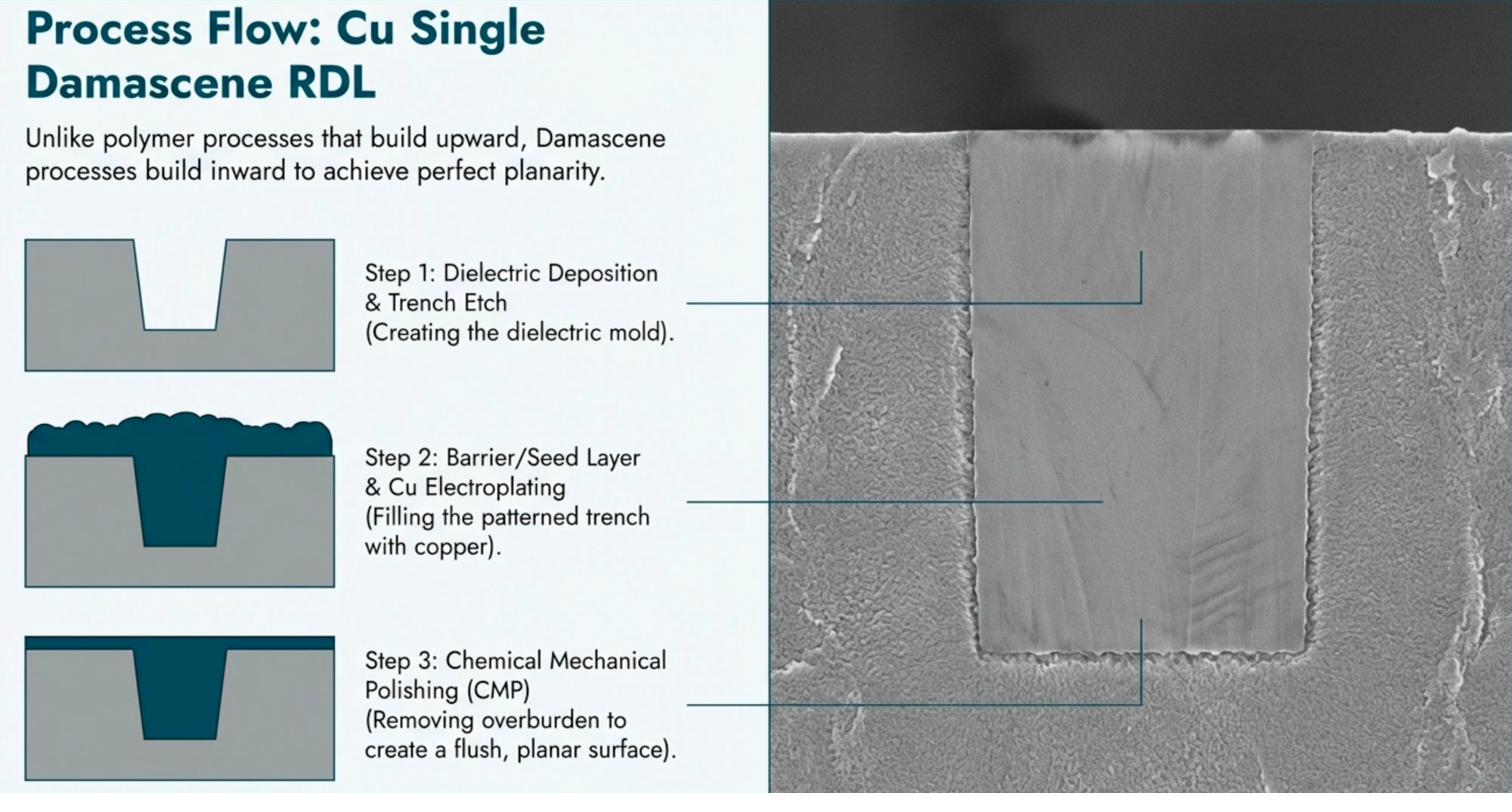
Cu Single Damascene RDL
Process Flow: Cu Single Damascene RDL - 3-step process: dielectric trench etch, Cu electroplating, CMP planarization with SEM cross-section
Process Flow
Cu Double Damascene RDL
Process Flow: Cu Double Damascene RDL - 3-step process: via and trench litho/etch, simultaneous Cu deposition, CMP with SEM cross-section
Polymer Dielectric Options
Four passivation materials BCB, PBO, Polyimide, Acrylic

The polymer dielectric choice determines the dielectric constant, cure temperature, chemical resistance, and application suitability of the RDL layer. Each material occupies a specific niche, our engineers advise based on your device requirements.

Polymer passivation dielectrics
Choose by dielectric constant, temperature, and application
BCB
Benzocyclobutene
Lowest dielectric constant (2.65) of any polymer RDL dielectric. Excellent planarity. Very low moisture absorption. Photosensitive BCB available, no separate etch mask needed. Cure at 210–250°C.
k = 2.65 · RF/mmWave
PBO
Polybenzoxazole
Low-k dielectric (2.9), excellent chemical resistance, and outstanding mechanical properties. Photosensitive, direct patterning without etch mask. Cure at 200–300°C. Preferred for fan-out FOWLP where multiple RDL layers are needed.
k = 2.9 · FOWLP
PI
Polyimide
The workhorse polymer dielectric, well-characterized, broad chemical compatibility, and high-temperature stability after cure (up to 400°C operation). Slightly higher k (3.2–3.5) than BCB/PBO. Biocompatible grades available for medical device RDL. Cure at 300–350°C.
k = 3.2–3.5 · Medical/flexible
Acrylic
Acrylic resin dielectric
Lowest cure temperature of the four options, typically 150–200°C. Ideal for RDL on substrates with strict thermal budget constraints. Lower chemical resistance than BCB/PBO/PI but sufficient for many fan-out and WLCSP applications where cost is the priority.
Lowest temp · Cost-sensitive
Cu Damascene Process Flow
Single and double damascene for fine-pitch multi-layer RDL

Cu damascene RDL uses the same principles as advanced CMOS BEOL, Cu inlaid into dielectric trenches and planarised by CMP, enabling the finest line/space achievable at wafer scale.

1

Dielectric Deposition

A CVD silicon dioxide or low-k dielectric is deposited conformally over the wafer surface, over the TSV contacts or device pads. The dielectric thickness determines the final Cu line height. For multi-layer RDL, each layer repeats this step on the CMP-planarised surface of the previous layer. Low-k CVD dielectrics (SiOCH or porous SiO₂) reduce RC delay in fine-pitch signal lines, important for RF and high-speed digital RDL applications above 10 GHz.

CVD SiO₂ Low-k CVD option SiOCH / porous SiO₂ Conformal deposition RC delay minimized
2

Trench & Via Lithography + Etch

In single damascene, via openings and metal trenches are patterned and etched in two separate lithography + etch steps. In double damascene, a single dual-pattern lithography step defines both via holes and the overlying metal trench simultaneously, the dielectric is then etched to form the combined via-trench geometry. The via connects to the layer below; the trench defines the horizontal wire geometry. After etching, photoresist is stripped and the dielectric surface is cleaned.

Single: 2-step via + trench Double: 1-step combined KrF or i-line lithography Dry etch, selective to dielectric Sub-2µm line/space
3

Barrier & Seed Layer Deposition

A thin Ta or TaN diffusion barrier is sputtered conformally into the etched trenches and vias, preventing Cu from diffusing into the surrounding dielectric. A Cu seed layer immediately follows. For fine-pitch damascene RDL, both barrier and seed must achieve step coverage into sub-5µm-wide trenches, requiring ionised PVD or atomic layer deposition (ALD) barrier processes. The seed layer thickness and conformality directly determines the uniformity of the subsequent electroplating fill.

Ta / TaN barrier Cu seed by iPVD ALD barrier for sub-5µm Conformal step coverage 4-point probe verification
4

Cu Electroplating

Copper is electroplated to overfill the trenches and vias, the Cu overburden must fill the trench completely with no voids before the CMP step can planarise. Superfill additive chemistry (accelerator, suppressor, leveller) drives bottom-up fill into the narrowest trenches, preventing seam voids that would create high-resistance line segments. Cu overburden thickness is controlled to minimize CMP removal time while ensuring complete fill. Post-plate inspection by optical microscopy confirms fill quality before CMP.

Superfill additive chemistry Bottom-up void-free fill Overburden controlled Post-plate optical inspection No seam voids
5

Cu CMP, Planarization

CMP removes the Cu overburden and barrier layer, stopping at the dielectric surface and leaving Cu inlaid only within the trenches and vias. Endpoint detection by eddy current on the Cu ensures uniform stop-on-dielectric across the wafer. Post-CMP metrology: Cu recess (dishing within wide lines), dielectric erosion, and within-wafer uniformity are measured and reported. The planarised surface is the base for the next RDL dielectric layer in multi-layer RDL, or for direct UBM and bumping in single-layer designs.

Eddy current endpoint Stop on dielectric Cu recess measured Erosion / uniformity QC Multi-layer ready
Packaging Architecture
Fan-in WLCSP and fan-out FOWLP both available

RDL is the enabling technology for both packaging architectures. The choice between fan-in and fan-out depends on the I/O count relative to die area, and the required package footprint.

📱

Fan-In WLCSP

Wafer-Level Chip-Scale Package

RDL redistributes bond pads from the chip's native pitch to a wider solderable ball pitch, entirely within the die footprint. No mold compound, no interposer. The package is the same size as the die. One or two RDL layers is typically sufficient. The smallest possible package form factor, ideal for mobile SoCs, MEMS sensors, RF chips, and IoT devices where PCB area is at a premium.

Polymer passivation RDL (BCB or PBO) is the standard route for WLCSP, low-k dielectric reduces RF parasitic coupling between adjacent signal lines, and cure temperatures below 300°C are compatible with completed CMOS.

Package = die size 1–2 RDL layers typical BCB / PBO dielectric Mobile · IoT · RF · MEMS No mold compound Smallest footprint
📦

Fan-Out FOWLP

Fan-Out Wafer-Level Package

Fan-out RDL extends I/O beyond the die edge into a mold compound area, enabling chips with more I/O than the die area can accommodate, and allowing multiple dies to be integrated side-by-side in a single package (eWLB, InFO, and similar approaches). The die is embedded in mold compound, reconstituted into a panel or wafer, and RDL is then fabricated across both the die and mold areas.

Multi-layer RDL (2–5 layers) is typical for fan-out because signals must be routed over a longer lateral distance. PBO is commonly used in fan-out due to its combination of low-k, photosensitivity, and high-volume process maturity. Fan-out enables chiplet integration at wafer scale.

Package > die size 2–5 RDL layers typical PBO dielectric eWLB · InFO · Chiplets Multi-die integration Higher I/O than die area
Process Specifications
Complete RDL fabrication
parameters
ParameterPolymer Passivation RDLCu Damascene RDL
Dielectric MaterialsBCB, PBO, Polyimide, AcrylicCVD SiO₂, low-k CVD (SiOCH)
Minimum Line/Space~5µm / 5µm<2µm / 2µm
Dielectric Constant (k)BCB: 2.65 · PBO: 2.9 · PI: 3.2–3.5SiO₂: 3.9 · Low-k: 2.5–3.2
Cure / Deposition Temp150–350°C (polymer dependent)CVD: 200–400°C
Metal Layers1–4 layers1–6 layers
Metal MaterialCu (electroplated) or Al (PVD)Cu (electroplated, inlaid)
BarrierTi/TiN or Ta (sputter)Ta/TaN (sputter or ALD)
Via FillCu electroplateCu electroplate (superfill)
PlanarizationNatural (polymer spins flat)CMP after each layer
PatterningPhotolithography (BCB/PBO: photosensitive)Lithography + dry etch
Fan-In / Fan-OutBothBoth
Typical ApplicationWLCSP, FOWLP, RF fan-out, MEMS2.5D interposer, HPC chiplet, fine-pitch
Wafer Size2 inch to 12 inch2 inch to 12 inch
UBM IntegrationENIG or ENEPIGENIG or ENEPIG
Bumping IntegrationC4 SnAgC4 SnAg
Applications
RDL across every segment
of advanced packaging
🔲

3D-IC Post-TSV Reveal

RDL immediately after TSV reveal CMP reroutes the exposed via contacts to the C4 bump pitch, directly continuing the packaging flow in the same coordinated project. Single RDL layer for low fan-out ratios; multi-layer for high-density interposer applications.

TSV reveal → RDL → UBM → C4 bump · no inter-vendor transfer
🧩

2.5D Chiplet Interposer

Fine-pitch Cu damascene RDL on silicon interposer provides sub-2µm line/space routing between CPU, HBM, and I/O chiplets. Multi-layer damascene RDL achieves the signal density that organic substrates cannot. The primary application driving Cu damascene RDL technology.

Cu damascene · Sub-2µm L/S · CPU + HBM chiplets · CoWoS / SoIC
📱

Mobile SoC WLCSP

Fan-in BCB or PBO RDL for application processor and modem chips in smartphones and tablets. Single or dual RDL layer redistributes hundreds of I/O pads to the ball pitch required for direct PCB attach. Low-k BCB minimizes crosstalk at RF frequencies used in 5G modems.

BCB / PBO · Fan-in WLCSP · 5G modem · Application processor
🔭

Silicon Photonics Packaging

Low-k BCB or PBO RDL on silicon photonics dies routes high-speed electrical I/O signals from the EIC (electronic IC) alongside optical waveguide ports. Dielectric loss in the RDL at 50+ GHz frequencies makes BCB (k=2.65) the preferred choice over higher-k alternatives.

BCB low-k · 50+ GHz · SiPho EIC · Co-packaged optics
🧲

MEMS Sensor WLCSP

Fan-in polymer RDL for MEMS inertial sensors (accelerometers, gyroscopes, pressure sensors), redistributes MEMS bond pads to ball grid for direct PCB attach in IoT devices, drones, and wearables. Eliminates the wire bond parasitics that degrade high-frequency MEMS performance.

Polymer RDL · Fan-in · MEMS IMU · Drones · AR/VR · IoT
📡

RF Front-End Modules

Fan-out PBO or BCB RDL for GaN/GaAs RF chiplets in 5G/6G front-end modules. Fan-out enables more I/O than the small MMIC die area provides. Low-k dielectric is mandatory, even moderate dielectric loss becomes unacceptable at millimetre-wave frequencies.

BCB / PBO · Fan-out · GaN/GaAs MMIC · 5G/6G mmWave FEM

Power Device Fan-Out

Polyimide RDL for SiC MOSFET and GaN power transistor fan-out packaging. Polyimide's high post-cure temperature stability (operation to 400°C) makes it the preferred dielectric for power RDL where device junction temperatures exceed what BCB or PBO can sustain.

Polyimide RDL · Fan-out · SiC MOSFET · GaN · High-temp stable
🏥

Medical & Implantable Devices

Biocompatible polyimide RDL for implantable neural probes, retinal implants, and ingestible sensor chips. Medical-grade polyimide is ISO 10993-assessed for biocompatibility, a requirement that BCB and PBO do not meet. Low-temperature acrylic RDL for sensors with strict thermal constraints.

Biocompatible PI · Implantable · Neural probe · Retinal implant
📦

eWLB / InFO Fan-Out Chiplets

Multi-layer PBO RDL on reconstituted fan-out panels for multi-die integration, two or more chiplets embedded side by side in mold compound with RDL routing signals between them and to the package balls. Enables chiplet integration without a silicon interposer for mid-tier HPC and networking ASICs.

PBO multi-layer · Fan-out panel · eWLB · InFO · Multi-die
Why Nanosystems JP Inc.
What makes our RDL capability
different
01

Both routes in one coordinated process flow

Polymer passivation RDL (BCB, PBO, PI, acrylic) and Cu damascene RDL (single and double), both available . No need to qualify a separate vendor for one route when your device requires properties that the other cannot deliver.

02

Immediate after TSV reveal, no transfer

RDL lithography starts immediately after reveal CMP clears the Cu contacts, while the surface is oxide-free and clean. The most common yield-loss mechanism in outsourced RDL is Cu surface oxidation during the days or weeks a wafer sits in transit between the reveal house and the RDL house. Eliminated here.

03

All four polymer dielectrics available

BCB for RF and mmWave, PBO for fan-out FOWLP, polyimide for high-temperature and biocompatible, acrylic for lowest cure temperature, our engineers match the dielectric to your device, not the other way around.

04

Sub-2µm line/space in Cu damascene

Cu damascene RDL achieving sub-2µm line/space, the density required for chiplet-to-chiplet routing on 2.5D silicon interposers. This specification is not achievable with polymer RDL approaches, and not available at standard packaging foundries that focus on 5–10µm minimum pitch.

05

RDL → UBM → C4 bumping

After RDL, UBM (ENIG or ENEPIG) and C4 SnAg bumping are performed in the same coordinated project, completing the full wafer-level packaging sequence without a third vendor for bumping. Your wafer goes from TSV reveal to bumped in one coordinated process flow, on one schedule.

06

Fan-in and fan-out, designed to spec

RDL layout is designed to your specific fan-out ratio and target bump pitch, not constrained to a fixed platform product. Whether you need a single-layer fan-in at 5µm line/space or a 4-layer fan-out damascene RDL for a chiplet interposer, the design is yours.

Next in your process flow

Packaging & Assembly: After RDL and UBM, final assembly, die bonding, wire bonding, flip-chip, and moulding, completes the device into its shipping format.

Packaging & Assembly →

Start your project.
Response within 1 business day.

Share your process requirements, substrate, and production volume, A Nanosystems JP Inc. engineer will respond within 1 business day. Full quote typically within 7–10 business days, subject to project complexity and NDA requirements.

[email protected] · +81-3-5288-5569 · NDA available on request

All Services
Full process flow →
Substrates
🔷 Substrate & WafersSi, SiC, GaN, glass, sapphire 🔬 Fused Silica WafersQuartz · borosilicate · low CTE 🟣 PI Film & SUS Sensor FabRoll-to-roll · sensor patterning
Front-End
🎭 Mask FabricationGDS to chrome mask, DRC 💡 PhotolithographyE-beam 20nm to 500×600mm 🔬 NanoimprintingUV & thermal NIL 🔵 Thin Film DepositionPVD, CVD, ALD, MBE ⬆️ LiftoffMetal pattern · shadow mask ⚡ ElectroplatingCu TSV fill, DPC, LIGA ⚗️ EtchingICP-RIE, DRIE >50:1 🌡️ AnnealingN₂/H₂/vacuum/RTA 🎯 Ion ImplantationB/P/As/Al/N implant 🔶 CMP & GrindingCu CMP, 50µm thinning ✂️ DicingBlade, stealth laser 🧪 Wafer CleaningRCA, plasma, megasonic
Advanced Packaging
🔗 Wafer BondingHybrid, eutectic, fusion 📌 TSV FabricationHigh AR, void-free Cu fill 🔓 TSV RevealBackgrind → etch → CMP 🪟 TGV FabricationThrough-glass via 📐 RDL FabricationBCB/PBO/PI + damascene 📦 Packaging & AssemblyWire bond, flip-chip 📚 3D/2.5D PackagingTSV+RDL+UBM+C4 🥇 AuSn BumpPVD lift-off, fluxless 🧬 Biochip & MicrofluidicsGlass 500×600mm, NIL 🔆 SiPho PackagingTSV·RDL·UBM·C4 for PIC
Industries
🤖 AI & HPC PackagingCoWoS-style, 2.5D/3D 💎 Silicon PhotonicsSOI · AuSn · TSV interposer 🚗 AutomotiveMEMS sensors, SiC power 🧬 Life SciencesLab-on-chip, biosensors 🔭 All Industries → Request a Quote →
Technical AI — Nanosystems JP Inc.
Online — typically replies in minutes
Services & Industries
⚙️ Capabilities Overview
Substrates
🔷 Substrate & WafersSi, SiC, GaN, glass, sapphire 🔬 Fused Silica WafersQuartz · borosilicate · low CTE 🟣 PI Film & SUS Sensor FabRoll-to-roll · sensor patterning
Front-End
🎭 Mask FabricationGDS to chrome mask, DRC 📷 PhotolithographyE-beam 20 nm to 500×600 mm 🔬 NanoimprintingUV & thermal NIL 🫧 Thin Film DepositionPVD, CVD, ALD, MBE ⬆️ LiftoffMetal pattern · shadow mask ⚡ ElectroplatingCu TSV fill, DPC, LIGA 🌊 EtchingICP-RIE, DRIE >50:1 🔥 AnnealingN₂ / H₂ / vacuum / RTA ⚛️ Ion ImplantationB / P / As / Al / N implant 🔄 CMP & GrindingCu CMP, 50 µm thinning 💎 DicingBlade, stealth laser 🧪 Wafer CleaningRCA, plasma, megasonic
Advanced Packaging
🔗 Wafer BondingHybrid, eutectic, fusion 📌 TSV FabricationHigh AR, void-free Cu fill 👁️ TSV RevealBackgrind → etch → CMP 🪟 TGV FabricationThrough-glass via 🔀 RDL FabricationBCB / PBO / PI + damascene 📦 Packaging & AssemblyWire bond, flip-chip 📚 3D / 2.5D PackagingTSV + RDL + UBM + C4 🥇 AuSn BumpPVD lift-off, fluxless 🧬 Biochip & MicrofluidicsGlass 500×600 mm, NIL 🔆 SiPho PackagingTSV · RDL · UBM · C4 for PIC
Industries
🤖 AI & HPC PackagingCoWoS-style, 2.5D / 3D 💡 Silicon PhotonicsSOI · AuSn · TSV interposer 🚗 AutomotiveMEMS sensors, SiC power 🧬 Life SciencesLab-on-chip, biosensors 🔭 All Industries → Request a Quote →