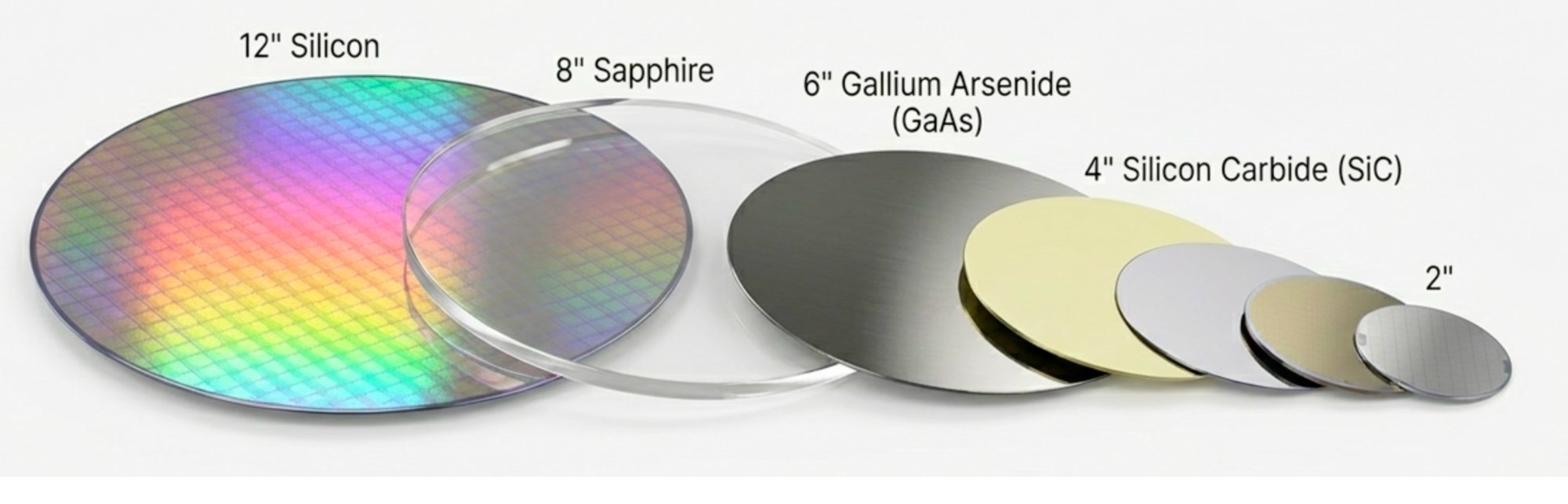
From foundational silicon to cutting-edge compound semiconductors, a complete four-tier portfolio supporting every stage of your project, from initial R&D through high-volume production.
The most widely used substrate in semiconductor fabrication. We supply silicon wafers across the full specification range, from research-grade test wafers to prime-quality production wafers with thermal oxide or thin film coatings.
Wet and dry thermal oxide SiO₂. High-quality gate oxide, isolation, or etch-stop layers. Available on prime wafers.
Thin film deposited wafers available in lots of 25, 50, and 100 wafers. Custom films on request.
Epi silicon on heavily doped substrate. N on N+, P on P+. Custom epi specifications on request.
Three glass types and three crystalline materials, chosen for optical properties, thermal stability, and chemical resistance. Each serves distinct application domains from displays to UV optics.
Renowned for optical applications and exceptional mechanical stability. The standard optical glass, low absorption in the visible spectrum, excellent homogeneity, and easy to polish and coat.
Valued for ease of fabrication, cost-effectiveness, and versatility for broad applications. The workhorse glass for display and large-format processing, low cost, readily available in large sheets.
Superior quality, clarity, and exceptional durability for specialized applications. Corning Eagle XG, the high-performance flat panel display glass with zero alkaline earth ion migration and low thermal expansion coefficient.
High purity, thermally stable, excellent optical and electronic properties with high-temperature resilience. Crystalline quartz for piezoelectric applications and precision optical components.
Optimal for UV to IR applications due to high transmission and low thermal expansion. The reference material for photomask substrates, deep UV lithography, and precision optical windows.
Extreme hardness (Mohs 9), broad transparency range, and resistance to both chemical and radiation damage. Substrate of choice for GaN epitaxy (LEDs/HEMTs) and harsh environment devices.
We empower ambitious projects by offering precise processing on glass substrates far exceeding standard wafer diameters. This enables display-panel-scale fabrication, large-format TGV interposers, and glass photomask production in one coordinated process flow.
SOI, SiC, and piezoelectric substrates, each designed for performance requirements that standard silicon cannot meet. Used in high-frequency RF, power electronics, and precision MEMS.
Prominent in electronics for its ability to reduce parasitic device capacitance. The buried oxide layer electrically isolates the active device layer, enabling faster transistors and lower power consumption.
A powerful combination of high-temperature resistance, high thermal conductivity, and suitability for high-frequency applications. The dominant substrate for EV power devices, industrial inverters, and solar energy systems.
Essential for SAW (Surface Acoustic Wave) filters, crucial for telecommunications. Lithium niobate and lithium tantalate are the standard substrates for mobile phone RF front-end filters at 4G/5G frequencies.
A unique combination of chemical inertness, high-temperature stability, and electrical conductivity. The material of choice for electrochemical sensors, bioelectrodes, and harsh chemical environment applications.
III-V compound semiconductors for photonics, RF, and power, materials that silicon simply cannot replicate. Each brings electron mobility, direct bandgap, or breakdown voltage properties beyond silicon's physical limits.
For high-speed electronics and photonics. InP has the highest electron velocity of any commercial semiconductor, enabling transistors operating at hundreds of GHz for telecom, radar, and 6G research.
Ideal for LED, laser, and various photonics applications. GaAs was the first direct bandgap semiconductor to enable efficient LEDs. Today it dominates high-brightness LEDs, solar cells, and RF front ends.
For high-frequency and high-power applications. GaN-on-SiC dominates 5G base station power amplifiers; GaN-on-Si enables cost-effective power transistors for EV chargers and industrial drives.
For photodetectors and solar cells. InGaAs is the standard near-infrared photodetector material, tunable bandgap by varying In content allows detection from 0.8µm to 3µm, covering all telecom bands.
Based directly on our substrate portfolio PDF. Use this matrix to quickly confirm which material suits your device's requirements. Contact us if your combination isn't shown.
| Material | General Purpose | Optical (Visible) | Optical (UV/IR) | High-Frequency | High-Power | High-Temp | Photonic/Laser |
|---|---|---|---|---|---|---|---|
| Silicon | |||||||
| BK7 Glass | |||||||
| Fused Silica | |||||||
| Sapphire | |||||||
| Quartz | |||||||
| SOI | |||||||
| SiC | |||||||
| LiNbO₃ / LiTaO₃ | |||||||
| GaN | |||||||
| GaAs | |||||||
| InP | |||||||
| InGaAs |
Matrix derived from Nanosystems JP Inc. substrate portfolio. ● indicates primary application fit.
Prime silicon (100) for bulk micromachining, SOI for surface MEMS with isolation, fused silica for low-thermal-noise resonators, quartz for piezoelectric gyroscopes.
4H-SiC for MOSFET and Schottky diodes targeting 650V–10kV. GaN-on-Si for 100–650V power transistors. GaN-on-SiC for RF power amplifiers.
RF-SOI for antenna switches and tuners. GaAs pHEMT for low-noise amplifiers. InP HEMT for mmWave/THz. LiNbO₃/LiTaO₃ for SAW/BAW filters.
Fused silica for UV to IR optical components. GaAs/InP for laser diodes and VCSELs. InGaAs for photodetectors. Sapphire for GaN LED epitaxy.
Large-format glass (BK7, Soda Lime, Eagle X) up to 550×650mm for TGV interposers. Lower cost and better RF performance than silicon for 2.5D/3D packaging.
Fused silica for chemically inert microfluidic channels. Glassy carbon for electrochemical bio-sensors and neural recording electrodes. Glass for lab-on-chip diagnostics.
Our process capabilities extend to non-wafer flexible and metallic substrates. Photolithography, PVD thin film deposition, and liftoff patterning are available on polyimide (PI) film and thin stainless steel (SUS) foil - enabling thin-film thermocouple fabrication, RTDs, flexible heaters, and precision sensor structures directly on these materials.
High-temperature polymer film for flexible sensors, heater patches, and conformal thermocouple arrays. Compatible with photolithography, PVD deposition, and liftoff.
Stainless steel foil for robust high-temperature thermocouples and strain gauges. Thermally conductive, corrosion-resistant. Requires dielectric isolation layer before sensor deposition.
Most substrate suppliers just ship wafers. We supply substrates as the first step in a complete fabrication project : your substrate spec is confirmed against your downstream process requirements before it's ordered.
From standard silicon to GaN epi-wafers, a single purchase order, a single contact, one quality system. No managing multiple substrate vendors for different materials in the same project.
We confirm your substrate specification against your process flow before ordering, so the resistivity, doping, and surface quality are right for your deposition or etching steps, not just the wafer supplier's standard spec.
550×650mm glass substrate processing is rare in Asia. We offer this at both the standard (370×470mm) and full large-format (550×650mm) sizes, enabling panel-scale TGV and display-substrate customers to work with a Japan-based partner.
🧪 Substrate cleaning: SC1, RCA, and piranha wet chemical cleaning available for all substrate types - including large-format glass panels up to 550×650mm. Supplied standalone or as part of a fabrication engagement.
Cleaning services →Share your process requirements, substrate, and production volume, A Nanosystems JP Inc. engineer will respond within 1 business day. Full quote typically within 7–10 business days, subject to project complexity and NDA requirements.